Contents
The Somewhat Reliable Narrator
A story pieced together from secondhand accounts, rumor, and one very smudged letter, about two kingdoms at war for so long nobody remembers why.
A Note About Sources
Before we begin, I should be honest with you.
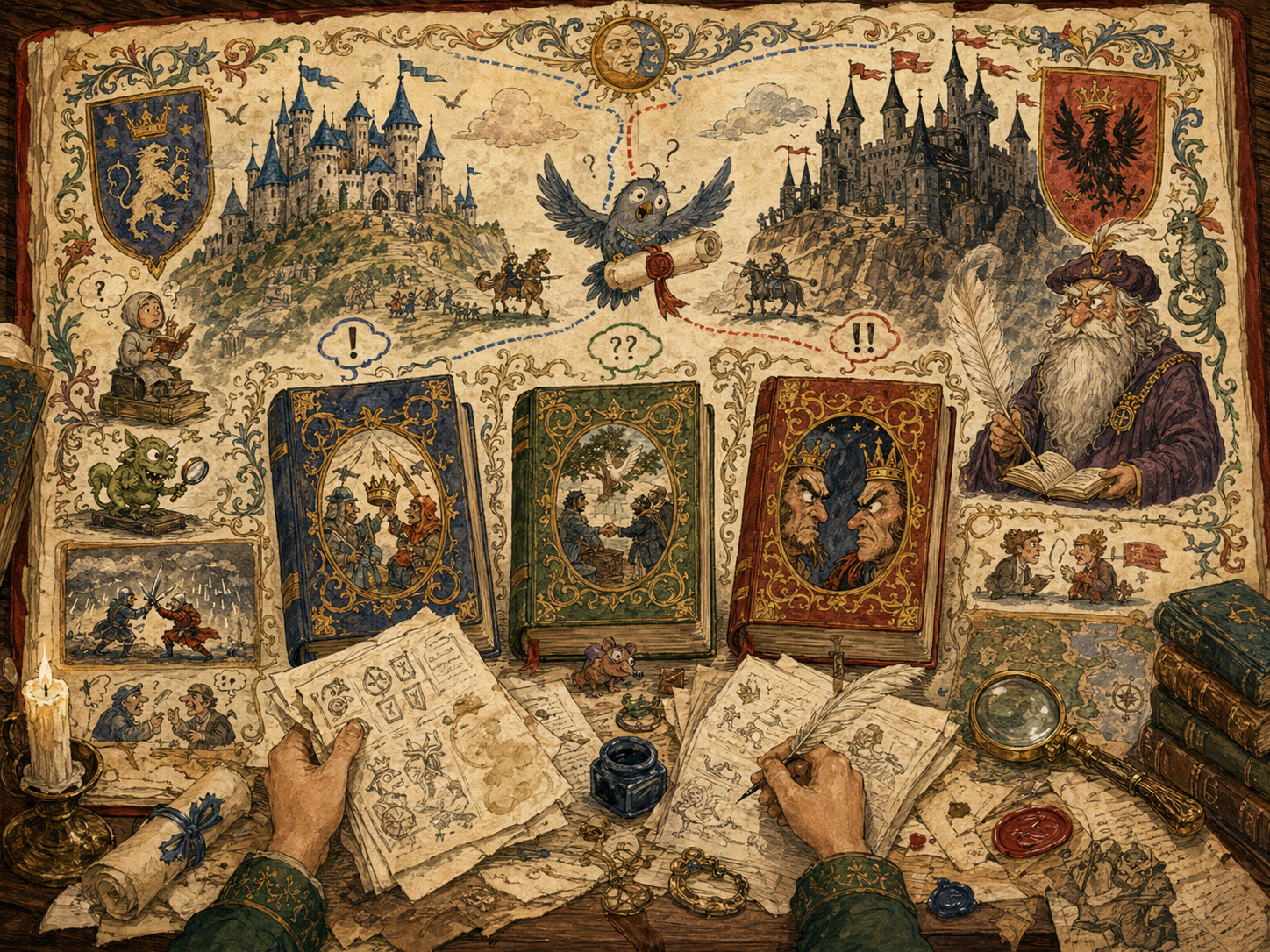
I wasn't there when any of this happened. Not in the castle, not at the border, not in the pigeon coop. I'm piecing this story together from a variety of sources: three official histories (which disagree on almost everything), seventeen personal letters (most of which are water-damaged), one diary entry that may or may not be a forgery, and a tavern song that rhymes "war" with "more" and "door" approximately seventy-four times.
I've done my best to assemble something resembling the truth. I make no promises about accuracy. When I'm uncertain, I'll say so. When the sources contradict each other, I'll pick the version that makes the better story.
This seems only fair.
Now then.
The Kingdom of Westmarch and the Kingdom of Easthollow had been at war for so long that no one alive could remember why.
This was not an exaggeration. Scholars had searched the royal archives. Historians had interviewed the oldest citizens. The Royal War Museum of Easthollow had an entire wing dedicated to "Origins of the Conflict," which contained approximately three hundred artifacts and zero explanations.
The war had simply always been happening, like weather or taxes.
"Why ARE we at war with Easthollow?" Prince Edmund of Westmarch once asked his father, King Harold the Adequate.
(I should note that King Harold earned his epithet not because he was particularly inadequate, but because a previous chronicler couldn't spell "Augustus" and the mistake was never corrected. This is, apparently, how history works.)
"They started it," King Harold replied, which was his standard answer to all questions about the war.
"But how? What did they do?"
"Something terrible, I'm sure." The king waved his hand vaguely. "Ask the War Council. They'll know."
The War Council did not, in fact, know. Neither did the Royal Historians, the Ministry of Grievances, or the Keeper of Ancient Grudges (a real position, apparently, though the current Keeper admitted he mostly just organized old scrolls and tried to look important).
The war continued anyway.
In Easthollow, the situation was remarkably similar. Queen Mathilda the Stern (who was actually quite cheerful in private but felt that monarchs should look imposing in portraits) held regular strategy meetings about a conflict she couldn't explain.
"Why ARE we at war with Westmarch?" Princess Rosalind once asked, interrupting such a meeting.
"They started it," Queen Mathilda replied.
"Everyone says that. Both sides say that."
"Well, someone must have started it."
"But WHO?"
Queen Mathilda looked uncomfortable. The War Council looked uncomfortable. The Royal Historian pretended to study a very interesting spot on the ceiling.
"These things are complicated, dear," the queen said finally. "Now please go practice your embroidery or something. The adults are busy."
Rosalind did not go practice embroidery. Rosalind went to the pigeon coop, because that was where she always went when adults were being useless.
The pigeon coop was her sanctuary. It sat at the top of the eastern tower, far from tutors and etiquette lessons and her six older sisters, who had opinions about everything and shared them constantly. The pigeons didn't have opinions. The pigeons just cooed and ate seed and occasionally delivered messages to the wrong destinations.
The most reliable messenger pigeon was named Gerald, though "reliable" was perhaps not the right word. Gerald had a strong sense of direction in the way that some people have a strong sense of fashion—meaning he was confident about it but frequently wrong. He had once delivered a birthday invitation to an enemy general, a love letter to a bakery, and a declaration of truce to a confused shepherd in the mountains.
But he was Rosalind's favorite, because he tried so hard.
"Hello, Gerald," Rosalind said, climbing into the coop and settling onto her usual perch. "Anything interesting today?"
Gerald cooed.
"That's what I thought."
She pulled out her sketchbook—not for embroidery, but for maps. Rosalind loved maps. She loved the idea that you could draw a line between two places and suddenly they were connected, even if everyone said they were enemies. On her best map, the border between Westmarch and Easthollow was marked with a dotted line and a small note: SEEMS ARBITRARY.
She was adding details to the Westmarch mountains when she heard a flutter of wings. A pigeon had arrived—not one of hers, but a stranger, looking tired and confused.
"Wrong coop, friend," she told it. "This is Easthollow. Where are you trying to go?"
The pigeon, naturally, said nothing. But there was a tiny scroll tied to its leg, and when Rosalind untied it, she found a message:
TO: The Royal Archives of Easthollow FROM: The Ministry of Historical Records, Westmarch RE: Formal Request for Pre-War Documentation
We are conducting a comprehensive survey of historical records pertaining to the Origin of the Current Conflict. If your archives contain any documents dated prior to the Initiation of Hostilities (date unknown), please forward copies at your earliest convenience.
We are particularly interested in any evidence that Easthollow started it.
Regards, The Ministry of Historical Records
Rosalind read it twice.
Then she laughed so hard that several pigeons flew away in alarm.
"They don't know either," she said to Gerald. "THEY DON'T KNOW EITHER!"
This changed things. If neither side knew why the war had started, then maybe—just maybe—it could be ended. Someone just had to be sensible about it.
She looked at the message again. It had been sent from the Ministry of Historical Records in Westmarch. Someone there was asking questions. Someone there was trying to figure things out.
Someone, she thought, who might be worth talking to.
She pulled out a fresh piece of paper and began to write:
TO: The Ministry of Historical Records, Westmarch FROM: A Concerned Citizen of Easthollow
I received your message by accident (I think your pigeon is lost) (they get that way sometimes) (it's the mountains, probably). I don't have access to the Royal Archives, but I've been wondering the same thing you're wondering: WHY IS THERE A WAR?
Nobody here knows either. I've asked. Everyone just says "they started it" and changes the subject.
Maybe we could figure it out together? Share information?
I realize this might be treason. I'm not sure. The laws about corresponding with the enemy are confusing. But the whole WAR is confusing, so I figure one more confusing thing won't hurt.
If you write back, please use a smarter pigeon. This one looks like it's been flying in circles.
Sincerely, Someone Who Asks Questions
She tied the note to Gerald's leg. He was, admittedly, not a smart pigeon. But he was HER pigeon, and she trusted him.
"Find the Ministry of Historical Records," she told him. "In Westmarch. That's the kingdom to the WEST. Do you understand? WEST."
Gerald cooed confidently.
He flew east.
"Gerald, NO—"
But he was already gone, disappearing into the evening sky, heading in completely the wrong direction.
Rosalind sighed.
The message would either arrive at its destination or it wouldn't. Either someone would write back or they wouldn't. Either something would change or everything would stay exactly the same.
She went back to her map, adding a small arrow pointing west and labeling it: THIS WAY TO ANSWERS. PROBABLY.
Now, you might be wondering: how did the message actually reach Westmarch, given that Gerald flew east?
The honest answer is: I have no idea.
The sources are unclear. One account suggests that Gerald got turned around by a storm and ended up going the right direction by accident. Another claims he landed on a merchant ship that happened to be sailing west. A third, rather implausible version involves a series of other pigeons passing the message along like a very slow and feathery postal service.
What matters is that three days later, the message arrived.
It landed on the desk of a young man who worked in the Ministry of Historical Records and who spent most of his time being ignored by adults.
His name was Edmund.
He was a prince, though he tried not to mention this at work. Princes were supposed to be learning sword fighting and diplomacy, not cataloging old documents. But Edmund had discovered that if you looked busy enough and kept your head down, adults mostly forgot you existed.
He opened the scroll, read it, and sat very still for a long moment.
Someone on the other side was asking the same questions he was asking.
Someone on the other side didn't know either.
He pulled out a fresh piece of paper and began to write.
TO: Someone Who Asks Questions FROM: Someone Else Who Asks Questions
I got your message. I don't know how—the pigeon looked exhausted and confused and possibly traumatized. I gave it some bread and water. It's sleeping now.
You're right. We don't know why the war started either. I've searched three hundred years of records and found exactly nothing useful. Just a lot of "CONFIDENTIAL - DO NOT READ" stamps on empty folders.
I want to know the truth. I suspect the truth might be embarrassing for someone, which is why it's so hard to find.
Write back if you can. Use a different pigeon if possible.
Sincerely, Someone Else
He tied the message to a ministry pigeon—a sensible, well-trained bird who actually knew which way was west—and sent it flying.
And so began a correspondence that would, eventually, change everything.
But that part comes later.
For now, two young people in two enemy kingdoms had discovered something remarkable: they were not the only ones asking questions.
That, as it turned out, was a very good place to start.
Correspondence
Over the following weeks, the letters flew back and forth across the border with remarkable frequency. Gerald, despite his directional challenges, somehow managed to deliver most of them—though the route he took was never the same twice and occasionally involved detours through neighboring kingdoms that had nothing to do with anything.
I have, through considerable effort, obtained copies of several of these letters. They make for interesting reading, though I should note that some portions are illegible due to water damage, pigeon-related incidents, and what appears to be jam.
I present them here, lightly edited for clarity.
Letter 4 FROM: Someone Who Asks Questions TO: Someone Else Who Asks Questions
I found something! In the Royal Library, there's a section called "Pre-Conflict Archives." It's in the basement. It smells like mold and everyone's forgotten about it.
Most of the documents are boring—grain reports, livestock counts, very detailed arguments about fence placement. But I found a reference to "The Incident of the Autumnal Delegation." It says: "Following the events of the delegation, relations between the kingdoms were IRREPARABLY DAMAGED."
What delegation? What events? IRREPARABLY DAMAGED HOW?
The next three pages are missing. Torn out. On purpose, I think.
Someone is hiding something.
Did you find anything on your end?
- Questions
Letter 5 FROM: Someone Else TO: Questions
I did! In our archives, there's a folder labeled "NEVER SPEAK OF THIS" (which is, honestly, a terrible way to keep a secret—it makes people want to speak of it immediately).
The folder contains a single document: a guest list for a diplomatic banquet, dated about three hundred years ago. The banquet was hosted by Westmarch to welcome a delegation from Easthollow.
The guest list includes names from both kingdoms. At the bottom, someone has scrawled: "DISASTER. SEE SUBSEQUENT REPORT."
There is no subsequent report. I looked everywhere.
But I noticed something strange. The banquet was held in the autumn. Your "Autumnal Delegation" must be the same event.
Something happened at that banquet. Something that started a war that's lasted three hundred years.
WHAT WAS IT?
- Else
Letter 7 FROM: Questions TO: Else
I asked my mother (the Queen) (I should mention that I'm a princess, I think I forgot to mention that) about the Autumnal Delegation.
She got very quiet and changed the subject.
When I pressed, she said: "Some things are better left in the past, Rosalind."
Then she realized she'd used my name and looked horrified. She told me to stop asking dangerous questions and go do something appropriate for a princess, like embroidery or fainting.
I don't embroider and I've never fainted in my life.
Anyway, now I'm even more curious. What could possibly be so terrible that it started a three-hundred-year war AND nobody wants to talk about it?
Do you think it was murder? It was probably murder. These things usually are.
- Rosalind (apparently we're using real names now)
P.S. - My pigeon (Gerald) is getting better at directions. He only went south once this time.
Letter 8 FROM: Else TO: Rosalind
My name is Edmund. I'm a prince, which I also forgot to mention. Fifth in line to the throne, which means I'm basically irrelevant to everyone except tutors who think I should be learning something useful.
I don't think it was murder. Murder would be in the official histories. Murder is dramatic—people like to write about it. Whatever happened at that banquet was embarrassing enough that everyone agreed to pretend it didn't exist.
I found another document. A receipt for a delivery to the royal kitchens the day before the banquet. The receipt lists: seventeen barrels of wine, forty wheels of cheese, two hundred loaves of bread, and (this is the interesting part) "one item, SPECIAL ORDER, DO NOT DISCUSS."
What was the special order? Why couldn't they discuss it?
I'm going to search the kitchen archives next. If they still exist.
- Edmund
P.S. - Your pigeon arrived covered in what I think is honey. I'm not going to ask.
Letter 11 FROM: Rosalind TO: Edmund
The kitchen archives! I didn't think of that!
I looked in ours. Most of the old records were thrown out years ago, but I found one ledger that survived because someone was using it to prop up a wobbly table in the pantry.
The ledger includes menus from three hundred years ago. The Autumnal Delegation banquet menu is there. Most of it is normal—roast meats, vegetables, fourteen kinds of pie (we really liked pie apparently).
But at the bottom, there's a handwritten note: "The Pie was not our fault. The recipe was provided BY THE GUESTS."
Guests meaning Westmarch. Your kingdom.
WHAT PIE? What was wrong with the pie?
- Rosalind
P.S. - I'm starting to think this whole war might be about food. Which would be incredibly stupid. But also believable.
Letter 14 FROM: Edmund TO: Rosalind
I found something.
Hidden in the back of a storage closet, behind seventeen years of tax records that nobody has ever looked at, there's a small locked box. I picked the lock (princes learn surprising skills when they're bored enough).
Inside the box was a single page. It's damaged—burned at the edges, water-stained—but I could make out most of it.
It's a recipe. For something called "The Triumphant Pudding."
The note at the bottom says: "Do NOT serve to Easthollow. Under ANY circumstances. By order of King Bartholomew."
King Bartholomew was king three hundred years ago. Right when the war started.
Someone served Easthollow a pudding they weren't supposed to have.
Is THAT what started the war? A PUDDING?
- Edmund
P.S. - If this is true, I'm going to be very annoyed.
Letter 15 FROM: Rosalind TO: Edmund
It's a pudding.
IT'S A PUDDING.
I found confirmation. There's an old painting in our castle's back hallway—everyone thought it was just a weird portrait of our ancestor looking angry. But I looked closer at the background, and there's a table, and on the table is a PUDDING, and underneath someone has painted (very small) the words: "NEVER FORGET."
Our ancestors went to war over a PUDDING.
I don't know whether to laugh or cry. Three hundred years. Thousands of soldiers. Countless resources. All because someone served a dessert that offended someone.
We need to tell people. We need to show them how ridiculous this is.
Meet me at the border. The old stone bridge at Midway Creek. I don't care if it's dangerous. I don't care if it's against the rules. This is too important.
One week from today. Noon.
Bring everything you've found.
- Rosalind
P.S. - I'm bringing Gerald. He got us into this; he should see how it ends.
Now, I should pause here to acknowledge something: these letters suggest a rather dramatic meeting at the border. The sources agree that such a meeting occurred. They do NOT agree on most of the details.
One account says it was raining. Another says it was beautiful and sunny. A third claims there was a minor earthquake, but I suspect that chronicler was being metaphorical.
What we know for certain is this: two young people, from two kingdoms at war, decided to meet face-to-face to share what they'd learned.
This was, by any reasonable standard, an extremely foolish thing to do.
It was also, as it turned out, exactly what needed to happen.
But I'm getting ahead of myself. The meeting comes next chapter. For now, let us simply note that sometimes the most important moments in history begin with nothing more than a series of letters, a confused pigeon, and the simple question: WHY?
The Realization
The old stone bridge at Midway Creek had been built three hundred and fifty years ago, during a brief period when Westmarch and Easthollow had been allies. It was meant to be a symbol of friendship—a place where travelers from both kingdoms could meet and trade and share news.
That was before the war.
Now the bridge was abandoned, overgrown with vines, and technically off-limits to citizens of both kingdoms. Signs on each end warned: BORDER CROSSING FORBIDDEN. VIOLATORS WILL BE DEALT WITH.
(The signs did not specify what "dealt with" meant. This was intentional. It sounded more threatening that way.)
Rosalind arrived first.
She had snuck out at dawn, telling her sisters she was going for a ride, which was technically true. She'd ridden to a farmhouse two miles from the border, left her horse with a confused farmer who owed her a favor, and walked the rest of the way through the woods.
Gerald was in a small cage strapped to her back. He cooed occasionally, in what she hoped was encouragement.
The bridge looked exactly as she'd imagined: old, forgotten, and vaguely romantic in a crumbling sort of way. She sat on the Easthollow side and waited.
She was nervous. This was, objectively, a bad idea. Meeting a stranger from an enemy kingdom, based entirely on letters delivered by an unreliable pigeon, could go wrong in approximately seven hundred ways. He could be lying about who he was. He could be a spy. He could have brought soldiers.
But he could also be exactly who he said he was: a curious boy who wanted to understand why his kingdom was fighting a war nobody could explain.
Rosalind was betting on the second option. She was usually right about people.
Edmund appeared at noon, exactly as promised. He came from the Westmarch side, walking carefully through the overgrown path, carrying a leather satchel that presumably contained his documents. He was shorter than she'd expected—about her height—with dark hair and an expression of nervous determination.
They stared at each other across the bridge.
"You're real," Edmund said, sounding relieved. "I was worried you might be a very sophisticated military trap."
"I was worried you might be a very sophisticated military trap," Rosalind admitted. "I'm glad we're both just... people."
"People who are technically committing treason."
"Minor treason. Petty treason. Is there such a thing as petty treason?"
"I don't think so. Treason is usually just... treason."
They stood in awkward silence for a moment.
"Should we meet in the middle?" Rosalind suggested. "Symbolically, I mean. Neutral ground."
"That seems appropriate."
They walked toward each other, meeting at the exact center of the bridge. Up close, Edmund looked tired—like someone who had been staying up late reading old documents and not sleeping enough. Rosalind probably looked the same.
"So," Edmund said. "A pudding."
"A pudding," Rosalind agreed. "Three hundred years of war. Thousands of deaths. Entire generations growing up hating each other. All because of a PUDDING."
"When you put it like that, it sounds ridiculous."
"It IS ridiculous. It was always ridiculous. The question is: what do we do about it?"
Edmund opened his satchel and pulled out the documents he'd collected. Rosalind did the same. They spread everything on the bridge's stone railing and began comparing notes.
"Here's what I've pieced together," Edmund said. "Three hundred years ago, Easthollow sent a diplomatic delegation to Westmarch. Everything was going well. Then, at the banquet, someone served a dessert called 'The Triumphant Pudding.'"
"Which was apparently offensive somehow."
"Very offensive. The Easthollow delegation left in the middle of the meal. By the next morning, both kingdoms had declared war."
Rosalind frowned at the recipe he'd found. "But why was it offensive? It's just a pudding. Sugar, cream, eggs, some kind of fruit preserve..."
"I don't know. There's nothing inherently insulting about the ingredients."
"Unless..." Rosalind pulled out the painting detail she'd sketched. "Look at this. The pudding in the painting—what shape is it?"
Edmund squinted. "Round, I think? With some kind of design on top?"
"It looks like it might be molded. Shaped like something. See these lines here?"
They both stared at it.
"Is that... a face?" Edmund asked slowly.
"I think it might be a face. A very lumpy, pudding-shaped face."
"Whose face?"
Rosalind's eyes went wide. "Oh no."
"What?"
"The Easthollow delegation three hundred years ago—it was led by King Archibald the Proud. He was famous for his enormous beard and his even more enormous ego. If someone made a pudding that was shaped like his face..."
"And then everyone ATE it..."
"In front of him..."
They looked at each other.
"They ate the king's face," Edmund said flatly. "They served a face-shaped pudding of the visiting king and then ate it while he watched."
"It would have been meant as an HONOR. 'Look, we made a pudding that looks like you! You're so important!' But if someone didn't explain that..."
"Or if someone DID explain it badly..."
"Or if King Archibald was already in a bad mood..."
"Which, given that his epithet was 'the Proud,' seems likely..."
Rosalind sat down heavily on the bridge railing. "This is worse than I thought."
"How is this WORSE? It's absurd! The whole thing is completely absurd!"
"That's why it's worse!" Rosalind waved her hands in frustration. "If the war had been started by something real—a murder, a betrayal, a genuine conflict of interests—then people might accept that it was time to end it. But THIS? If people find out the war started because of a PUDDING MISUNDERSTANDING, they'll be mortified. Humiliated. Three hundred years of pride and sacrifice and national identity, all based on a DESSERT."
Edmund was quiet for a moment. "You think they won't want to know the truth."
"I think they'll HATE the truth. It makes everyone look stupid. It makes the whole war look pointless."
"The war IS pointless."
"WE know that. But our parents, our generals, everyone who's ever lost someone in this conflict—they've been telling themselves it means something. That their sacrifices were for a reason. If we prove the reason was a pudding that looked like a king's face..."
Edmund sat down next to her. Gerald cooed softly in his cage.
"So what do we do?" Edmund asked. "Give up? Pretend we never found out?"
"I don't want to give up." Rosalind stared at the creek flowing beneath them. "I just... I don't know how to make people accept something this embarrassing."
"Maybe we don't have to make them accept it. Maybe we just have to make them look at it."
"What do you mean?"
"Right now, nobody talks about the war's origin. It's all 'they started it' and changed subjects. What if we force the conversation? What if we get the evidence in front of so many people that they CAN'T ignore it?"
Rosalind considered this. "That would require getting into both kingdoms' official archives. Gathering undeniable proof. And then somehow presenting it publicly."
"Sounds impossible."
"It sounds extremely difficult. There's a difference."
Gerald cooed again.
Rosalind looked at her pigeon—the confused, directionally-challenged bird who had somehow managed to connect two strangers across enemy lines. If Gerald could do the impossible, maybe they could too.
"We need more evidence," she said finally. "What we have is suggestive, but not conclusive. If we're going to convince anyone, we need the actual recipe, the actual records, something that proves beyond doubt what happened."
"The recipe I found was from Westmarch. Do you have Easthollow's version?"
"I have references to it, but not the actual document. It might be in the Royal Vault—the secure archive where they keep the most sensitive historical materials."
"We have a Royal Vault too."
"Then we each need to find a way into our kingdom's vault." Rosalind stood up, suddenly energized. "We get the original documents. We compare them. We build an irrefutable case. And then we figure out how to present it."
"This sounds like it could take months."
"Probably. Are you willing to keep going?"
Edmund looked at her—this princess from an enemy kingdom, standing on a forbidden bridge, proposing they continue their treasonous investigation.
"I've got nothing better to do," he said. "Fifth in line to the throne, remember? Nobody expects anything from me. Might as well use that for something worthwhile."
Rosalind smiled. "Partners, then?"
"Partners." He shook her hand formally, then immediately felt silly about it. "Should we... schedule another meeting? Or just keep using the pigeons?"
"Pigeons for now. Gerald is unreliable, but he's getting better." She glanced at the cage, where Gerald was attempting to eat a small stick. "Mostly better."
"I'll send my pigeon if I find anything important."
"I'll do the same."
They gathered their documents and prepared to leave, heading back to their respective kingdoms.
"Rosalind?" Edmund called, just before she disappeared into the Easthollow woods.
She turned. "Yes?"
"Thank you. For writing back. For not thinking I was crazy."
"You're not crazy. You're just asking questions. There's nothing crazy about questions."
"Tell that to my father."
"Maybe someday I will." She smiled. "Good luck with the vault."
"Good luck with yours."
And then she was gone, and Edmund was alone on the bridge, holding a collection of documents about a pudding that had started a war.
Gerald cooed from somewhere in the distance, already flying the wrong direction.
Some things, Edmund reflected, never changed.
But some things could. With enough evidence, enough courage, and enough confused pigeons.
He started walking home.
The real work was about to begin.
The Journey
I should tell you something important: this chapter took the longest to reconstruct.
The sources become fragmentary here—scattered notes, half-finished journal entries, one truly unhelpful map that appears to have been drawn by a child (or possibly an adult with no artistic ability). What follows is my best attempt at piecing together events that even the participants themselves seem to have found confusing.
What I know for certain: Rosalind and Edmund both attempted to access their kingdoms' Royal Vaults. Both failed. Both decided to try something more drastic.
What I am less certain about: almost everything else.
Let's begin.
Rosalind's attempt to enter the Easthollow Royal Vault lasted exactly fourteen minutes.
The vault was located beneath the castle, guarded by two soldiers, three locked doors, and one extremely suspicious archivist who had been protecting old documents since before Rosalind was born.
"I need to see the pre-war records," Rosalind announced, trying to sound authoritative.
"No," said the archivist.
"I'm a princess."
"You're the SEVENTH princess. Come back when you're first, second, or at least top five."
"But it's important—"
"Everything is important to someone. These documents are important to HISTORY. And history says you can't come in without written authorization from the Queen, the Keeper of Records, AND a note from your governess."
"My governess?"
"Proves you've done your lessons. Can't have uneducated people touching delicate materials."
Rosalind retreated to consider her options.
Meanwhile, in Westmarch, Edmund was having similar problems.
"I need to see the pre-war records," Edmund announced, also trying to sound authoritative.
"No," said the Westmarch archivist, who was apparently a universal type.
"I'm a prince."
"You're the FIFTH prince. Come back when you matter."
"But—"
"Next!"
There was no one behind him. The archivist was just being dramatic.
They compared notes via pigeon. (Gerald arrived four days late, covered in mud, with the message partly eaten. The essential information survived.)
Can't get in, Edmund wrote. Archivists are the worst.
Same here, Rosalind replied. We need another plan.
The new plan was simple, foolish, and inevitable: if they couldn't access the records through official channels, they would access them through unofficial ones.
They would break into the vaults.
At night.
Simultaneously.
"This is a terrible idea," Edmund muttered to himself as he studied the castle blueprints he'd... borrowed from the engineering office.
"This is a terrible idea," Rosalind muttered to herself as she practiced picking locks on her bedroom door.
They proceeded anyway, because terrible ideas are often the only ideas available when you're twelve years old and trying to end a three-hundred-year war.
The night of the vault expeditions—which occurred simultaneously in both kingdoms, on the same moonless night, because they'd coordinated via pigeon (a minor miracle of timing)—was later called "The Night of Historical Theft" by absolutely no one, because nobody knew it happened except the participants.
I present the events in parallel, reconstructed from journal entries written after the fact.
Rosalind's Version:
10 PM: Snuck out of chambers. Used the old servants' passage behind the tapestry. Nobody uses that passage anymore because it's full of spiders. I do not like spiders. But I like war even less.
10:30 PM: Reached the vault entrance. Guards were playing cards. Waited for them to get distracted by an argument about cheating (one guard definitely cheated).
10:47 PM: Picked the first lock. (Thank you, book on "Mechanical Curiosities" that I found in the library.)
10:52 PM: Picked the second lock. Hands shaking. This is treason. Actual treason. Not petty treason. REGULAR treason.
11:15 PM: Third lock is HARDER. Who designed this? Someone who hates future princesses, that's who.
11:34 PM: INSIDE. The vault smells like dust and old paper and disappointment. Began searching for pre-war documents.
11:47 PM: Found the section. Everything is labeled "CLASSIFIED - AUTUMNAL INCIDENT." Grabbed everything I could carry.
12:03 AM: Heard footsteps. Hid behind a shelf. Archivist came in to check on something. Did not look behind the shelf. My heart was beating so loud I thought he'd hear it.
12:15 AM: Archivist left. Escaped via the same route. Did not encounter spiders this time. Small miracle.
12:45 AM: Back in chambers. Shaking. Cannot believe that worked.
Edmund's Version:
10 PM: Left my rooms. Told the guard I was going to the library. Guards don't care about the library. Nobody cares about the library except me.
10:20 PM: Reached the vault through the old drainage tunnels. They're dry now but they still smell like the sixteenth century.
10:35 PM: Only one guard tonight. He was ASLEEP. This kingdom's security is embarrassing.
10:40 PM: Locks were easier than expected. I think nobody's changed them in a hundred years.
11:00 PM: Inside the vault. It's organized. I'm impressed. Started looking for pre-war materials.
11:22 PM: Found a section labeled "DO NOT OPEN - HISTORICAL EMBARRASSMENTS." This is definitely it.
11:30 PM: Found the original pudding recipe. It's here. It's REAL. There are notes in the margins. Someone wrote: "This was a mistake."
11:45 PM: Also found a letter. A formal apology from King Bartholomew to King Archibald. It was never sent. Someone wrote "BURN THIS" on it, but they never did.
12:00 AM: Left the vault. Guard still asleep. Made it back to my rooms without being seen.
12:15 AM: I have the evidence. Real evidence. Now what do we do with it?
They met again at the bridge three days later. This time, they brought their findings.
"Look at this," Edmund said, spreading the unsent apology letter on the stone railing. "King Bartholomew tried to apologize. He wrote: 'We deeply regret any offense caused by the ceremonial pudding. It was meant to honor Your Majesty, not to insult you. The dessert's resemblance to your noble countenance was intended as a tribute.'"
"He called it a TRIBUTE," Rosalind said flatly.
"He was trying!"
"Look at this." Rosalind pulled out a document from her pile. "It's a letter from King Archibald's advisor to our ministers. It says: 'His Majesty was prepared to overlook the pudding incident until he observed the Westmarch court LAUGHING while consuming the dessert. This was taken as deliberate mockery.'"
"They laughed?"
"Apparently the pudding was DELICIOUS. People were enjoying it. King Archibald thought they were laughing at HIM."
Edmund rubbed his forehead. "So the war started because people were happy eating a good dessert."
"And because nobody explained what was happening."
"And because the apology was never sent."
"Someone wrote 'burn this' and then DIDN'T burn it. Why?"
Edmund looked at the letter. "Pride? Stubbornness? By the time someone might have sent it, maybe too much had already happened?"
"Three hundred years of too much," Rosalind agreed.
Gerald cooed from his perch on the bridge railing. He had somehow arrived BEFORE them this time, which was unprecedented.
"So we have the evidence," Edmund said. "We have the original recipe, the unsent apology, the advisor's letter, all the documentation. What now?"
Rosalind had been thinking about this. "We need to show everyone at once. Both kingdoms. If we show just one side, they can deny it, call it enemy propaganda. But if both kingdoms see the evidence at the same time, from sources inside their OWN archives..."
"A simultaneous revelation."
"Exactly."
"How do we do that?"
Rosalind smiled. It was not a reassuring smile. It was the smile of someone who had just had an idea that was either brilliant or disastrous.
"The Harvest Festival," she said. "It's in two weeks. Both kingdoms celebrate it on the same day. There will be public gatherings, speeches, everyone in one place."
"You want to disrupt the Harvest Festival."
"I want to use the Harvest Festival. We each present the evidence in our own kingdom, at the same time, in front of as many people as possible."
"That's... that's extremely public."
"That's the point. If we do it privately, it can be suppressed. If we do it publicly, everyone knows. They can't pretend they didn't hear it."
Edmund thought about this. His father would be furious. His brothers would be embarrassed. The entire kingdom would have to confront the fact that they'd been fighting for three centuries over a dessert.
"They'll hate us," he said quietly.
"Maybe. Or maybe they'll finally be free to stop fighting." Rosalind met his eyes. "Are you with me?"
Edmund looked at the evidence spread before them. The recipe for the Triumphant Pudding. The unsent apology. The letter describing a king's wounded pride. All of it ridiculous. All of it real.
"I'm with you," he said.
They shook hands again, less awkwardly this time.
"Two weeks," Rosalind said. "We prepare our presentations, gather our courage, and change history."
"Or get arrested for treason."
"One or the other. Possibly both."
Gerald cooed in what might have been encouragement.
They walked back to their respective kingdoms, carrying evidence of the most pointless war in history.
Behind them, the bridge stood empty, waiting for whatever came next.
The Investigation
I need to pause here and admit something uncomfortable: I don't know exactly what happened in the two weeks between the bridge meeting and the Harvest Festival.
My sources become remarkably vague during this period. There are references to "preparations" and "difficulties" and, ominously, "the incident with the goat," but no details. One letter suggests that Edmund nearly gave up twice. Another indicates that Rosalind's sisters became suspicious and had to be distracted with an elaborate scheme involving a false suitor.
What I can tell you is this: on the morning of the Harvest Festival, both kingdoms woke to discover that something had gone terribly wrong.
And by "terribly wrong," I mean: the parents had finally noticed.
In Easthollow, Queen Mathilda the Stern was having a very stern morning.
"You've been CORRESPONDING," she said to Rosalind. "With the ENEMY."
Rosalind considered denying it. But Gerald was sitting on her shoulder, looking extremely guilty (if pigeons can look guilty), and her bag full of classified documents was sitting on the floor between them where a guard had dropped it after searching her room.
"Technically," Rosalind said, "I've been conducting historical research."
"With the ENEMY."
"The enemy has relevant archives."
Queen Mathilda's eye twitched. "Guards found you trying to leave the castle at dawn. You had DOCUMENTS. STOLEN documents. From our OWN vault."
"I was going to give them back."
"You were going to EXPOSE them. At the FESTIVAL. In front of EVERYONE."
Rosalind saw no point in lying further. "Yes."
"Do you have any idea what you've done?"
"I've discovered that this entire war is based on a misunderstanding about a pudding, and I was trying to tell people so they could stop fighting."
There was a long silence.
"A pudding," Queen Mathilda said flatly.
"A pudding shaped like King Archibald's face. People ate it. He was offended. Nobody apologized. War."
"That's... that's ridiculous."
"I know. That's the point. The whole war is ridiculous. It's ALWAYS been ridiculous. And nobody talks about it because they're too embarrassed to admit they don't know why they're fighting."
Queen Mathilda sat down heavily in her chair. She looked, for a moment, less like a stern monarch and more like a very tired mother.
"How did you even discover this?"
"Letters. With someone in Westmarch. We both asked the same questions and shared what we found."
"Someone in... who?"
Rosalind hesitated. But Edmund was probably having this exact same conversation right now, in his own castle. There was no point in protecting secrets anymore.
"Prince Edmund. The fifth prince. He's like me—nobody pays attention to him, so he had time to investigate."
"You've been collaborating with an enemy prince."
"I've been collaborating with someone who wanted to know the truth. The enemy part is just... geography."
Meanwhile, in Westmarch, King Harold the Adequate was having a conversation that was almost word-for-word identical.
"You've been CORRESPONDING," he said to Edmund. "With the ENEMY."
"Technically—"
"There's no 'technically' in treason, Edmund!"
"It's not treason to want to understand history. I was just asking questions."
"You were planning to HUMILIATE this kingdom in front of everyone at the Festival!"
Edmund stood his ground. "I was planning to tell the TRUTH."
"The truth is that Easthollow attacked us!"
"No, Father. The truth is that we served their king a pudding shaped like his face, everyone laughed, he felt mocked, and nobody ever apologized. THAT'S the truth. I have the documents. I have the original recipe. I have the letter you—our ancestors—wrote but never sent."
King Harold went pale. "The letter was supposed to be destroyed."
"It wasn't. It's been sitting in the vault for three hundred years, marked 'burn this,' and nobody ever did. Because deep down, SOMEONE knew it was wrong to hide the truth."
The king was quiet for a long moment.
"How long have you known?"
"Weeks. Rosalind and I—"
"Rosalind?"
"Princess Rosalind. Of Easthollow. We've been working together."
King Harold sank into his throne. He looked old suddenly—older than Edmund had ever seen him.
"You've been working with the enemy. Trading secrets. Planning public revelations. And you did all this... why?"
"Because the war is STUPID." Edmund's voice cracked, but he didn't stop. "Because people are dying for a reason nobody understands. Because my whole life I've been told to hate Easthollow, but I've never known WHY, and when I finally figured it out, the answer was a DESSERT. A three-hundred-year war over HURT FEELINGS about a DESSERT."
"It wasn't just a dessert—"
"Yes it was! It was EXACTLY a dessert! And nobody wanted to admit it because it's embarrassing, and now generations of embarrassment have killed more people than any pudding ever could!"
Edmund was breathing hard. He'd never yelled at his father before. He'd never yelled at ANYONE before.
King Harold stared at his son for a long moment.
Then he said something unexpected: "You sound like my grandfather."
"What?"
"My grandfather. Your great-grandfather. He used to say the war was pointless. Used to say someone should find out how it started and end it. Nobody listened to him. They said he was too young, too naive, didn't understand politics." The king's voice was soft. "He died in a border skirmish when I was five years old."
Edmund didn't know what to say.
"I've spent my entire reign fighting this war," King Harold continued. "Because that's what kings do. That's what my father did, and his father, and HIS father. It never occurred to me to ask why. It was just... the war. How things were."
"How things don't have to be," Edmund said quietly.
"Perhaps." The king looked at the documents Edmund was clutching—the recipe, the letter, all of it. "You really were going to show these to everyone?"
"I was going to try."
"And the Easthollow princess—Rosalind—she has her own evidence?"
"She has documents from their archives that confirm everything."
King Harold stood and walked to the window. Outside, the kingdom was preparing for the Harvest Festival. Banners were being hung. Food was being prepared. Soon, the square would be full of people.
"The Festival starts in three hours," the king said.
"I know."
"If we do this—if we reveal this—there's no going back. Three hundred years of national identity, rewritten by a pudding."
"Three hundred years of pointless fighting, ended by the truth."
King Harold turned to look at his son. Fifth in line to the throne. Ignored. Overlooked. And somehow, more capable than anyone had realized.
"You really think this will work?"
"I think it might. And I think not trying is worse than failing."
The king nodded slowly. "Then I suppose we'd better talk to Easthollow."
"Talk to—?"
"If we're going to do this, we should do it together. Both kingdoms. Both revelations. At the same time." He smiled faintly. "That was your plan, wasn't it? Simultaneous exposure so neither side could deny it?"
"Yes, but... you're helping?"
"Someone has to. And apparently, the adults in this family have been useless for three hundred years." He put a hand on Edmund's shoulder. "Let's go send a message to Queen Mathilda. I believe you know a pigeon?"
Gerald, for once, flew the right direction on the first try.
Perhaps he knew that this time, it mattered.
Or perhaps he'd finally learned which way west was.
Either way, the message arrived.
And an hour later, against all odds and expectations, something unprecedented happened: the royal families of two enemy kingdoms agreed to meet.
Not on a battlefield.
Not through intermediaries.
But face to face, at the border bridge, to discuss a pudding.
History, as they say, was about to be made.
(I should note that some sources claim there was a second pigeon involved in the negotiations, and that Gerald was actually off eating bread somewhere during this crucial moment. I choose to believe Gerald was central to events. It makes for a better story.)
The Confrontation
The meeting at the border bridge was, by all accounts, extremely awkward.
I have three eyewitness descriptions of this event, and they agree on almost nothing except this: everyone stood in uncomfortable silence for far too long before anyone spoke.
On the Westmarch side: King Harold the Adequate, Prince Edmund, and a small group of anxious advisors who kept checking to make sure this wasn't an elaborate trap.
On the Easthollow side: Queen Mathilda the Stern (looking particularly stern), Princess Rosalind, and an equally anxious group of advisors who were checking for the same thing.
In the middle of the bridge: nobody, because nobody wanted to be first.
"Well," King Harold said finally. "This is uncomfortable."
"Extremely," Queen Mathilda agreed.
They stared at each other.
"Your son," the queen said, "has been corresponding with my daughter."
"Your daughter has been corresponding with my son."
"They've uncovered something rather embarrassing about our war."
"So I've been told. A pudding."
"A pudding shaped like King Archibald's face, which your kingdom served at a diplomatic banquet and then ate while laughing."
"The laughing was because the pudding was delicious. Not because of mockery."
"And you know this... how?"
"I read the original recipe. It was genuinely good pudding. Apparently."
More awkward silence.
Edmund and Rosalind exchanged glances. Their parents were circling each other like two cats who weren't sure whether to fight or flee.
"Perhaps," Rosalind said carefully, "we should show them the evidence. All of it. Together."
The adults looked at their children—these troublesome young people who had, somehow, done what three centuries of diplomats and generals couldn't.
"Go on, then," Queen Mathilda said. "Show us."
Edmund and Rosalind stepped into the center of the bridge. They laid out their documents side by side: the recipe, the unsent apology, the advisor's letter, the painting detail, the classified files from both vaults.
"Here's what we know," Edmund began. "Three hundred years ago, Westmarch hosted a diplomatic banquet for Easthollow. As a tribute to King Archibald, they created a special dessert: the Triumphant Pudding, shaped like the king's face."
"It was meant to be an honor," Rosalind continued. "Like a portrait, but edible. A celebration of the guest of honor."
"But nobody explained this to King Archibald beforehand."
"So when the Westmarch court began eating the pudding—"
"Enthusiastically—"
"Because it was delicious—"
"King Archibald thought they were mocking him." Edmund held up the advisor's letter. "This letter confirms it. He felt humiliated. He left the banquet, and by morning, both kingdoms had declared war."
"But here's the thing," Rosalind said. "King Bartholomew of Westmarch tried to apologize." She held up the unsent letter. "He wrote this. He explained the misunderstanding. He begged for forgiveness. But someone wrote 'burn this' on it, and it was never sent."
"Why?" King Harold asked. His voice was quiet.
"Pride, probably," Edmund said. "By the time the letter was written, war had already started. Sending it would have meant admitting a mistake. So someone filed it away and pretended it didn't exist."
"And then," Rosalind concluded, "it was just... easier to keep fighting than to explain what had happened. Every generation forgot a little more of the truth, until nobody knew why the war started. They just knew that it HAD started, and that the other side was the enemy."
The adults stared at the documents.
King Harold picked up the recipe. "The Triumphant Pudding," he read. "Flour, butter, cream, sugar, twelve eggs, essence of vanilla, strawberry preserve for the noble complexion..."
"It sounds delicious," Queen Mathilda admitted reluctantly.
"It was meant to be. It was meant to be the BEST pudding anyone had ever made, in honor of the visiting king."
"But nobody TOLD him that."
"No. Nobody told him."
More silence. But this silence was different. Thoughtful rather than hostile.
"Three hundred years," Queen Mathilda said softly. "All those soldiers. All those families. All those... everything. For a PUDDING."
"For a lack of communication about a pudding," Rosalind corrected. "The pudding itself was innocent."
"The pudding was DELICIOUS," King Harold added, still reading the recipe. "According to everyone who ate it."
Queen Mathilda turned to look at him. They had never met before—not in person. They had written threatening letters. They had sent armies against each other. But they had never stood this close.
"Your ancestors started this," she said, but her voice lacked conviction.
"Your ancestors CONTINUED it. For three hundred years."
"So did yours."
"I'm not denying that."
They stared at each other. Then, slowly, King Harold began to smile. It was a small smile, slightly embarrassed, but unmistakably real.
"This is absolutely absurd," he said.
"Completely ridiculous," Queen Mathilda agreed.
"We've been enemies for generations over a DESSERT."
"A dessert that looked like my great-great-great-great-something grandfather's face."
"A very distinguished face, by all accounts."
"He had an excellent beard."
"The pudding had an excellent beard too, apparently. The recipe mentions 'spun sugar for the noble whiskers.'"
Queen Mathilda laughed. It was a short, surprised sound, like something escaping against her will.
"This is what our children discovered," she said. "While we were busy planning military campaigns and teaching them to hate each other."
"They figured it out in a few months. We've had three centuries."
"To be fair," Edmund offered, "you were all rather busy fighting."
"Fighting about NOTHING," his father said. "Fighting because our parents fought, because THEIR parents fought, because nobody wanted to be the first to ask WHY."
"Somebody should have asked," Queen Mathilda said. "Somebody should have asked a long time ago."
"We're asking now," Rosalind said. "And we're not just asking—we're answering. The question is: what do we do about it?"
Both monarchs looked at each other across the bridge. The advisors on both sides were remarkably quiet, probably still processing the idea that their entire professional lives had been based on a pudding dispute.
"We could announce a truce," King Harold said slowly. "A temporary cessation of hostilities while we... investigate."
"Investigate what? The evidence is right here."
"While we PRETEND to investigate. Give people time to adjust. Let the news sink in gradually."
"Or," Queen Mathilda said, "we could do what should have been done three hundred years ago."
"Which is?"
She held up the unsent apology letter. "Actually apologize."
King Harold blinked. "Now?"
"Now. Today. In front of witnesses. A formal apology for the pudding incident, three hundred years late." She looked at the letter. "This should have been sent to my ancestor. It never was. But I could accept it now, on his behalf."
"And I could offer it. On behalf of mine." King Harold straightened. "An apology from the House of Westmarch to the House of Easthollow, for any offense caused by a celebratory pudding intended as an honor."
"And an acceptance from the House of Easthollow, with acknowledgment that the offense was unintentional and regrettable."
"And then," King Harold said, almost smiling, "perhaps we could discuss... not being at war anymore?"
"Gradually. These things take time."
"Of course. Treaties to negotiate. Borders to establish. Probably forms to fill out."
"Definitely forms. Kingdoms run on forms."
They looked at each other, and something shifted. Not friendship—not yet—but something better than enmity. Something that might, in time, become understanding.
"Your daughter is quite remarkable," King Harold said.
"Your son is equally remarkable. Did you know he picked three locks to get into your vault?"
"He did WHAT?"
"Later, Father," Edmund said quickly. "That's a conversation for later."
Rosalind grinned at him across the bridge.
Gerald, perched on Rosalind's shoulder, cooed triumphantly. Even he seemed to understand that something important had just happened.
"The Harvest Festival is starting soon," Queen Mathilda observed. "In both kingdoms. Crowds are gathering."
"Perhaps we should make an announcement," King Harold said. "Both of us. Together. Before our people spend another day celebrating a war that never needed to happen."
"Together," Queen Mathilda agreed.
They turned to face their respective sides of the bridge.
"PEOPLE OF WESTMARCH AND EASTHOLLOW," King Harold began, his voice carrying across the water. "TODAY, SOMETHING UNPRECEDENTED HAS OCCURRED..."
I should note that the speech that followed has been recorded in seventeen different versions, none of which agree on the exact wording. What all versions do agree on is that, by the end of the speech:
- Both kingdoms knew the truth about the war.
- Both kingdoms were extremely embarrassed.
- A formal truce was declared, pending further negotiations.
- And somewhere, in the gathered crowds, someone started laughing—and the laughter spread, because sometimes the only reasonable response to absurdity is joy.
The war wasn't over. Not yet. Three hundred years of conflict couldn't be undone in a single afternoon. There would be treaties to write, grievances to address, wounds to heal.
But for the first time in three centuries, people on both sides of the border looked at each other and saw something other than enemies.
They saw fellow victims of a very, very bad joke.
And somehow, that made all the difference.
The Resolution
One year later, the kingdoms of Westmarch and Easthollow were still not at peace.
This might seem like a disappointing ending. You've followed Rosalind and Edmund through their investigation, their discovery, their dramatic revelation. You've watched two monarchs apologize for a pudding on an ancient bridge. Surely, you might think, that should have fixed everything.
But wars don't end that easily. Even ridiculous wars. Even wars that everyone agrees should never have started. There are soldiers to bring home, borders to redraw, trade routes to reestablish. There are old resentments that can't be erased by a single speech, and new grievances that arise when people who have been enemies for generations suddenly have to learn how to be neighbors.
The truce held. That much I can tell you with certainty. In the year following the revelation, there were no battles, no skirmishes, no midnight raids. The armies returned to their barracks. The border guards stood down. The warning signs on the old stone bridge were replaced with ones that simply said: BRIDGE UNDER REPAIR.
(The bridge was, in fact, being repaired. It had been neglected for three centuries, and it turned out that vines, while picturesque, were not great for structural integrity.)
But if the war wasn't over, something important had changed: people were TALKING.
Not just kings and queens. Not just diplomats and generals. Regular people. Farmers on either side of the border discovered they had similar problems with irrigation. Merchants realized they'd been missing out on three centuries of trade. Children who had been taught to hate their neighbors began to wonder if maybe the hate was optional.
And in the middle of all this, two young people kept writing letters.
Dear Edmund,
The peace negotiations are going slowly. Mother says this is normal—that "lasting peace takes longer than quick war." I'm not sure that's true, but she seems hopeful.
The archivists are speaking to me again, though they're still upset about the vault break-in. I've offered to help reorganize the pre-war section as an apology. They seemed surprised that I knew how to organize things. I think they expected me to be less competent than I am.
Gerald is doing well. He made it to Westmarch in only two wrong turns last time. I consider this a personal victory.
How are things on your end?
- Rosalind
Dear Rosalind,
Father put me in charge of the Historical Reconciliation Committee. I think he did it partly as punishment for the lock-picking, and partly because he genuinely thinks I'm good at this sort of thing. I'm not sure how I feel about being rewarded for treason.
We've been going through the old war records, identifying inaccuracies. Turns out, a LOT of what we were taught was wrong. Not just about the pudding—about everything. Both sides exaggerated their victories and minimized their defeats. The "Glorious Battle of Miller's Field" was apparently more of a "Confused Skirmish Near Some Cows." Nobody wants to admit this.
I've started a new project: a complete, honest history of the war. Both sides' perspectives. No propaganda. Just facts, as best we can determine them.
It's going to take years. Maybe decades.
I think it will be worth it.
- Edmund
Dear Edmund,
Your honest history project sounds wonderful. Would you like help? I've become rather good at finding hidden documents and interpreting badly preserved sources.
Also, I should mention: I'm coming to Westmarch. Officially. As part of a diplomatic delegation. My first official diplomatic mission, which is ironic given that my unofficial diplomatic mission is what started all of this.
We'll be there for a month, negotiating trade agreements. Very boring, but it means I can actually SEE you instead of just writing. And perhaps meet this "someone else" who helped end a war.
Unless you've become too important for old friends.
- Rosalind
P.S. - Gerald is coming. He's very excited. Or possibly just hungry. It's hard to tell with pigeons.
Dear Rosalind,
I will never be too important for old friends. Especially old friends who taught me that asking questions isn't treason, even when adults say it is.
Come to Westmarch. We'll show you the vault you inadvertently embarrassed, and the Historical Society where all our evidence is now properly archived, and the bakery that's trying to recreate the Triumphant Pudding recipe.
(Yes, really. Someone decided that if a pudding started the war, a pudding should help end it. They're calling it "Reconciliation Pudding." It's surprisingly popular. Nobody eats it in front of portraits anymore, though. Just in case.)
Safe travels. Say hello to Gerald for me.
- Edmund
The diplomatic delegation arrived in Westmarch on a sunny morning in early spring. It was the first official visit from Easthollow in over three hundred years, and the entire capital turned out to watch.
Rosalind walked at the front of the delegation, next to Queen Mathilda. She was wearing official diplomatic attire—uncomfortable but impressive—and carrying, in a small cage, one thoroughly confused pigeon.
Gerald had insisted on coming. Or rather, Rosalind had insisted on bringing him. He was, after all, the one who had started this. That misdirected message, that first accidental contact, had changed everything.
(Gerald was currently attempting to eat his own feathers. He was still not the smartest pigeon. But he was the most historically significant.)
The Westmarch welcoming party stood in the castle courtyard. King Harold looked appropriately regal. His advisors looked appropriately nervous. And at the edge of the group, looking neither regal nor nervous but simply happy, stood Edmund.
He caught Rosalind's eye across the courtyard and smiled.
She smiled back.
Later, after the official greetings and the formal dinners and the lengthy speeches about cooperation and reconciliation, they found a quiet moment on the castle balcony.
"You did it," Edmund said. "We did it."
"We did SOMETHING," Rosalind corrected. "The war isn't over yet."
"But it will be. Eventually. Because of what we started."
"Because of what Gerald started, really. If he hadn't flown the wrong direction that first time..."
"Gerald is a very important historical figure. I've noted this in my new history book."
Rosalind laughed. "He'll be thrilled. He can't read, but he'll be thrilled."
They looked out over the city—a city that had been enemy territory when they'd first begun writing, and now was simply... a city. Foreign, but not frightening. Different, but not dangerous.
"I've been thinking," Edmund said. "About what comes next."
"The peace treaties. The trade agreements. Years of careful diplomacy."
"Yes, all of that. But also..." He hesitated. "I want to write a book. A real book, not just historical records. About how this happened. How two people who should have been enemies became friends instead."
"That could be dangerous. Some people still don't like the truth."
"I know. But I think... I think stories matter. The story we were told—that Easthollow was evil, that the war was just—that story kept people fighting for three centuries. Maybe a new story, a true story, could help people understand that things can change."
Rosalind was quiet for a moment. Then she said: "I'd like to help. If you want a co-author."
"I was hoping you'd say that."
"Two perspectives. Both sides. Just like the investigation."
"Exactly like the investigation." Edmund smiled. "We make a good team."
"We make an UNLIKELY team. A princess and a prince who were supposed to be enemies."
"The best teams are always unlikely. The likely ones never accomplish anything interesting."
From somewhere inside the castle, the sound of music drifted out—the first official ball between the two kingdoms in three hundred years. People who had never met were dancing together, learning each other's steps, finding common ground.
Gerald cooed from his perch on the balcony railing. He had somehow escaped his cage again. Nobody knew how.
"Should we join the ball?" Rosalind asked.
"In a moment. I want to remember this first." Edmund looked at the stars, at the city, at the future spreading out before them. "The night the war really ended. Not with a treaty, but with a dance."
"It hasn't ended yet."
"No. But it will. And this is where it started to end. Right here. Right now."
Rosalind thought about this. About the letters, and the bridge, and the pudding. About Gerald flying the wrong direction. About two kingdoms learning, slowly, how to stop being enemies.
"You know what the funny thing is?" she said.
"What?"
"If that first message had gone to the right place—to the actual archives, like it was supposed to—none of this would have happened. A clerk would have filed it away. Nobody would have answered. We never would have connected."
"Gerald's terrible sense of direction saved two kingdoms."
"Gerald's terrible sense of direction saved two kingdoms," Rosalind agreed. "I'm going to make sure that goes in the history books."
They stayed on the balcony a little longer, watching the stars. Then, together, they went to join the dance.
I told you at the beginning of this story that I wasn't there when any of this happened. That I pieced it together from incomplete sources, contradictory accounts, and one very smudged letter.
This is all still true.
But I've done my best to tell the story as it happened—or at least, as it might have happened. The essential facts are accurate: there was a war, it was based on a misunderstanding, and two young people who should have been enemies chose to be friends instead.
The details? Well. You've read what I have. You can decide for yourself what you believe.
What I can tell you with certainty is this:
The war did end, eventually. The peace treaty was signed three years after the Harvest Festival revelation. Both kingdoms prospered. The border bridge was fully repaired and became a popular meeting place for travelers from both lands.
The Triumphant Pudding recipe was officially renamed "The Friendship Pudding" and is now served at every major diplomatic function. It is, by all accounts, delicious. Nobody eats it in front of portraits.
Edmund and Rosalind did write their book. It was controversial, praised by reformers and criticized by traditionalists. It became required reading in both kingdoms' schools. Generations of children learned that asking questions wasn't just acceptable—it was necessary.
Gerald lived to the remarkable age of seventeen, which is very old for a pigeon. He was given a state funeral. Both kingdoms sent representatives.
And somewhere, in a quiet corner of history, the lesson remained:
Wars are easier to start than to end. But sometimes, all it takes to change everything is a single question, asked by someone brave enough to listen for the answer.
Why are we fighting?
It's worth asking.
It's always worth asking.
THE END
Note from the Somewhat Reliable Narrator:
If you've made it this far, thank you for trusting me with this story. I've done my best, but I'm sure I got some things wrong. History is like that—full of gaps and guesses and well-intentioned mistakes.
If you ever find better sources than the ones I used, I hope you'll write your own version. The truth, after all, belongs to everyone who looks for it.
And if a confused pigeon ever delivers a message to your window by mistake...
Consider answering.
You never know where it might lead.