Contents
Phillis Wheatley and the Words of Liberty
Phillis Wheatley was brought to Boston in bondage and became one of the most remarkable poets of the Revolutionary era. This factual narrative follows her life, her writing, her meeting with fame, and the hard limits the new nation placed around freedom.
Chapter 1: A Child Taken Across the Atlantic
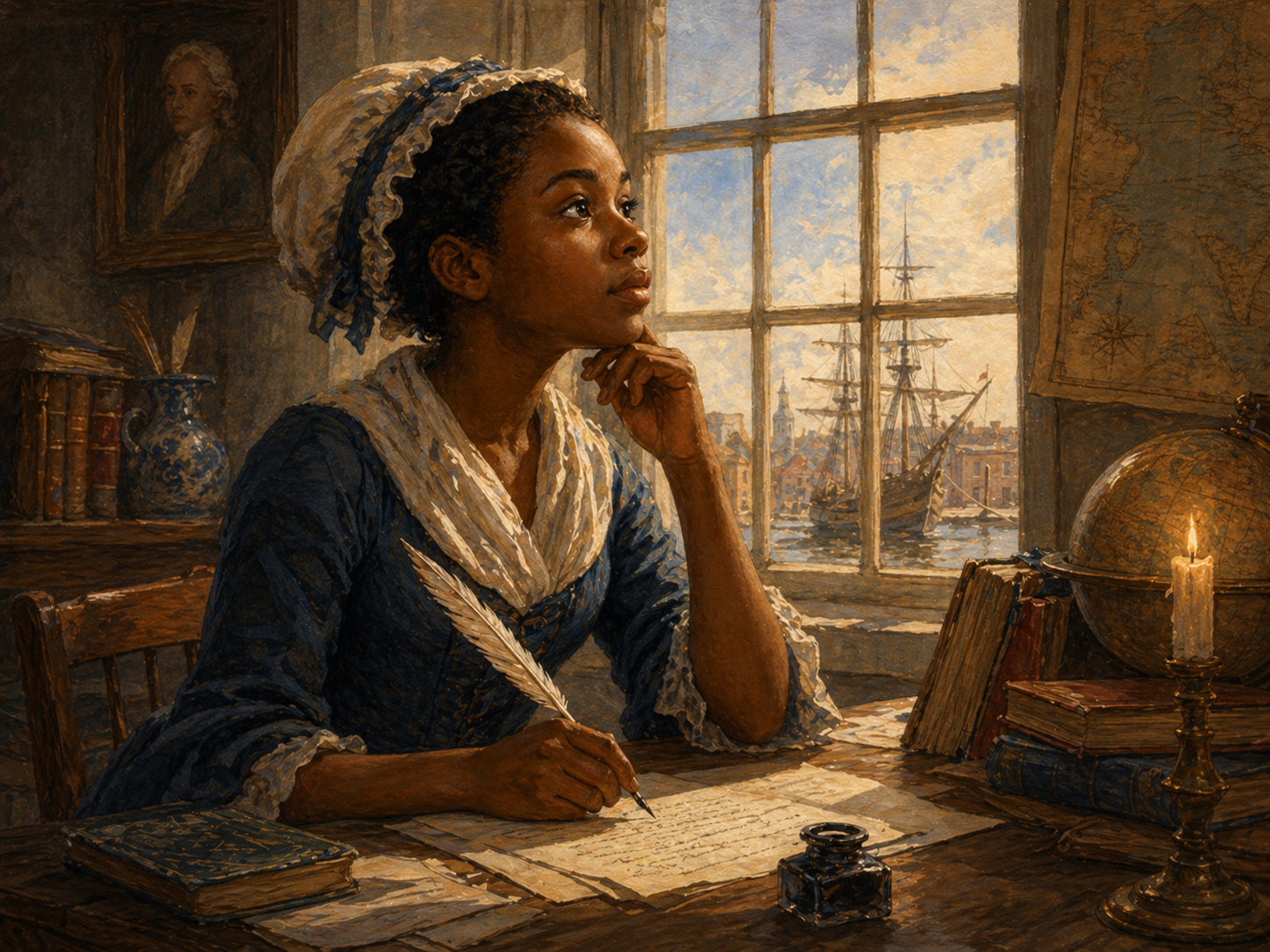
Phillis Wheatley entered recorded history through violence.
She was born in West Africa, probably in the region that is now Senegal or Gambia, around 1753. The exact details of her family, language, and early childhood are not fully known. That loss is not accidental. The Atlantic slave trade broke families, erased names, and turned children into cargo. What later generations know about Phillis begins only after she had already been taken from her home.
In 1761, when she was still a young child, she was transported across the Atlantic aboard a slave ship called the Phillis. The name she would later carry came from that ship. In Boston she was purchased by the Wheatley family, who gave her the name Phillis Wheatley.
This beginning matters because it places her life inside one of the central contradictions of the eighteenth-century Atlantic world. The same era that spoke increasingly of liberty, rights, reason, and human improvement also maintained and defended slavery. Phillis Wheatley would become one of the clearest voices of the Revolutionary age, yet she entered that age in chains.
The Wheatley family did not treat her in the same way many enslaved owners treated those they held. That fact is true, but it must be handled carefully. A household may behave less brutally than others and still participate fully in slavery. Phillis was owned. Her labor and legal status were controlled by others. The unusual part of her life lies not in the justice of that arrangement, which did not exist, but in what happened next.
The Wheatleys recognized quickly that she was gifted.
This recognition changed the course of her life. She was taught to read and write in English, and she learned with astonishing speed. The Wheatley children, especially Mary Wheatley, seem to have played a large role in her education. Phillis also studied the Bible, history, geography, and classical literature. Such education was extraordinary for an enslaved African girl in colonial America. It was extraordinary even for many free girls.
Boston in the 1760s and 1770s was a city alive with argument. It was a port, a commercial center, and increasingly a center of resistance to British rule. Newspapers circulated. Sermons carried political force. Crowds gathered. Debates over taxation, representation, and imperial power sharpened year by year. Phillis grew up in a place where language mattered intensely, and she had unusual access to that language.
This helped shape her gift.
She began writing poetry while still very young. Her poems showed not only technical skill but also a remarkable command of religious and classical references. Readers in Boston and beyond were startled. A Black girl who had been brought from Africa as a slave had learned to write polished verse in English. For some readers, the surprise became admiration. For others, the surprise became suspicion. They doubted that she could truly have written the poems herself.
This reaction reveals as much about colonial prejudice as it does about Phillis's talent. White readers who accepted the idea that Africans were naturally inferior struggled to explain a poet who contradicted their assumptions. If Phillis Wheatley was real, then some of their racial theories were not.
The demand for proof would follow her as her reputation grew.
Even before that public test, however, Phillis had already accomplished something enormous. She had taken a language imposed upon her through enslavement and made it serve her own mind. This does not erase the violence of her beginning. It makes her achievement more striking. Her story is not one of a gentle path to culture. It is the story of brilliance asserting itself through a system designed to deny full humanity.
At the same time, her writing cannot be reduced to simple protest poetry of the modern kind. Phillis wrote within the literary conventions of her day. She drew on Christianity, neoclassical forms, public elegy, and political praise. Some readers later wished her poems sounded more openly rebellious. That expectation misses the difficulty of her position. She was writing from inside a world where her freedom, livelihood, and public standing were all fragile.
The more important point is that she wrote at all, and that what she wrote was powerful enough to force the Atlantic world to notice.
Phillis Wheatley's life began with dislocation, renaming, and enslavement.
It would continue with one of the most remarkable literary rises in early American history.
Chapter 2: Learning to Read, Learning to Write
Phillis Wheatley's education moved with extraordinary speed.
Within about sixteen months of arriving in Boston, she had learned enough English to read difficult texts. This fact is often repeated because it is astonishing, and it should be. But the speed of her learning matters for more than amazement. It helps explain why Phillis became such a powerful challenge to the assumptions of her age. She did not merely become literate. She entered the intellectual world of the eighteenth century at a level many free and privileged people never reached.
Her reading included the Bible, which shaped much of her imagery and moral language. It also included classical authors, mythology, and the polished poetic conventions that educated readers admired. Phillis learned to write within forms that elite audiences recognized. This was one reason her poetry could travel. She spoke in a literary language that powerful readers understood.
That did not mean she sounded like everyone else.
Even when Phillis wrote in expected forms, her very existence on the page altered the meaning of what readers saw. A Black woman born in Africa and enslaved in America was writing learned poetry in English and addressing public themes. She was not supposed to exist in the imagination of many colonial readers. Yet there she was, composing elegies, moral reflections, and political verse.
One of her earliest published poems, written on the death of the preacher George Whitefield in 1770, gained wide notice. Whitefield was famous across the Atlantic world, and elegies written in his memory circulated quickly. Phillis's poem stood out. Readers praised the emotional force and technical skill of her lines, and her name began to travel beyond Boston.
Recognition, however, did not erase prejudice. On the contrary, wider fame brought wider disbelief.
In 1772, as a collection of her poems prepared for publication, Phillis had to endure one of the most revealing ordeals in early American literary history. A group of prominent Boston men examined her to determine whether she had really written the poems attributed to her. Their attestation, later printed in her book, stated that they believed the poems were indeed her work.
The document is valuable and humiliating at the same time.
It is valuable because it helped her book reach publication. It is humiliating because it shows what kind of proof a Black poet needed simply to be believed. White authors were not typically summoned before a panel to establish that they possessed minds. Phillis was.
Her book, Poems on Various Subjects, Religious and Moral, was published in London in 1773. This too matters. London, not Boston, offered the practical path to publication. The transatlantic world that enslaved Phillis also carried her words outward into print. The book made her one of the earliest published poets of African descent in the English-speaking world and certainly the most famous in British North America at the time.
Publication brought prestige, correspondence, and readers in both Britain and America. It also did not free her fully into a secure literary life. Phillis moved in a world where praise could be genuine and still remain limited by racism. Admirers could celebrate her talent while refusing larger changes in the system that had enslaved her. This was one of the great moral failures of the age.
Still, her writing mattered politically as well as artistically. The Revolutionary crisis was deepening. Debates over liberty filled Boston and the colonies. Phillis's life itself stood as a test of what those words meant. How could a people argue passionately for their own rights while holding others in bondage?
Her poetry did not always attack slavery as directly as later readers might wish. But she did write lines and letters that spoke to human equality, Christian judgment, and the moral emptiness of pride. She also carefully crafted public relationships with influential figures, using poetry as a way to enter the political conversation of her time.
This did not make her merely strategic. It made her realistic.
For Phillis Wheatley, writing was not just self-expression. It was presence. It was proof. It was entry into a world that had not intended to admit her. She showed that literary mastery could become a form of argument even when the poem's tone remained polished, religious, or ceremonial.
By the early 1770s, then, Phillis had moved from enslaved child newly arrived in Boston to published poet known across the Atlantic. That transformation would have been remarkable under any conditions. Under hers, it was extraordinary.
And it placed her in the middle of the Revolutionary era just as the struggle over liberty became louder than ever.
Chapter 3: A Poet in a Revolutionary City
Phillis Wheatley lived in Boston at a moment when political language was catching fire.
The city was one of the great centers of imperial argument in British North America. Crowds had protested taxes. The Boston Massacre had sharpened anger. Tea had been dumped into the harbor. British authority and colonial resistance were colliding more openly each year. Newspapers, sermons, pamphlets, and speeches carried ideas through streets already tense with possibility.
Phillis was not outside that atmosphere. She absorbed it and wrote within it.
In 1775 she composed a poem addressed to George Washington, praising him in elevated language as leader of the American cause. The poem imagined Columbia, a poetic figure for America, and presented the revolutionary struggle in grand heroic terms. Washington responded respectfully and invited Phillis to visit him in Cambridge, where he was commanding the Continental Army.
The exchange mattered for several reasons.
First, it showed that Phillis Wheatley was not merely a local curiosity or a literary novelty. She was taken seriously enough that the commander in chief of the Continental Army acknowledged her publicly. Second, it placed her directly inside the political symbolism of the Revolution. Her words could move from printed page to the center of national struggle.
Yet the exchange also sharpened the contradiction of the age. Washington himself was a slaveholder. The patriot cause spoke of liberty while slavery endured. Phillis Wheatley, a poet who had been enslaved, was praising a revolution led in part by men who did not extend full freedom to all.
This contradiction does not erase the importance of her writing. It helps explain why her life is so historically valuable. She lets us see the Revolutionary era from inside its own unfinished moral language.
Phillis was manumitted around 1773, likely before or near the publication of her book. The exact personal and legal details are less important than the result: she was no longer enslaved. Yet freedom in law did not automatically become security in life. Economic vulnerability, racial prejudice, and the instability of wartime society still circled her.
The Wheatley household itself also changed. Susanna Wheatley, who had supported Phillis's literary career, died in 1774. John Wheatley died later. The family environment that had made her education possible was disappearing. For a writer whose public standing remained fragile, this mattered enormously.
Still, Phillis continued to write and to represent something larger than herself. In the eyes of abolitionists and some reform-minded readers, she became evidence against racist claims about African inferiority. In the eyes of other readers, she remained an exceptional case, praised precisely so that the system as a whole need not be questioned too deeply. This too is a familiar pattern in history: societies admire one extraordinary person while resisting what that person's life implies.
Phillis's poetry also reveals her skill in navigating difficult audiences. She wrote in ways that could be published and respected while still carrying deeper implications about humanity, religion, and judgment. Her Christianity mattered here. Christian language gave her a moral framework strong enough to address equality and pride without always speaking in open political challenge. That was not cowardice. It was a disciplined way of writing under constraint.
Modern readers sometimes ask whether Phillis Wheatley was revolutionary enough. The better question is what sort of revolution was available to her. A woman, Black, African-born, and only recently freed, writing in the eighteenth century could not operate with the same public freedom as a male pamphleteer or politician. What she did instead was claim intellectual authority in a society built to deny it.
That claim was radical in its own right.
Boston gave her the setting. The Revolution gave her themes and readers. Her own talent gave her the power to turn language into presence.
By the mid-1770s, Phillis Wheatley had become one of the most unusual public voices in the new nation's emerging story. Yet the years ahead would show how narrow admiration can become when unsupported by deeper justice.
Chapter 4: Fame, Freedom, and the Limits of a New Nation
Phillis Wheatley's life after her first great burst of fame was harder than many readers expect.
This matters because national memory often likes uplifting arcs. A gifted child overcomes severe obstacles, publishes a famous book, meets powerful people, and is welcomed into history. Phillis Wheatley's real life did not unfold so neatly. The same country that admired her poetry did not build a secure place for her to live as a writer.
In 1778 she married John Peters, a free Black man who was ambitious, energetic, and often unstable in fortune. Their marriage placed Phillis in a difficult economic world. The Revolutionary War disrupted trade and everyday life. Opportunities were limited. Peters struggled with debt and business failure. Phillis's own literary prospects weakened in a country at war and in a society still deeply shaped by racism.
She continued writing, and there is evidence that she planned a second volume of poems. That second volume was never published during her lifetime. The reasons were not literary failure. They were material. Printing required money, support, and a reading public willing to sustain her. Those supports thinned.
This is one of the cruelest parts of her story. A poet who had once been celebrated on both sides of the Atlantic found herself unable to convert reputation into durable security. Praise had been real, but it had limits. The new nation could honor her talent in words more easily than it could help sustain the life of the woman who possessed it.
Phillis Wheatley Peters died in 1784, still young, in poverty. Several of her children died young as well. The image is hard to accept precisely because her early promise had been so extraordinary. Yet it reveals something essential about the Revolutionary era. It was a time of expanding ideals and severe limits. Freedom was praised, but not distributed equally. Talent was admired, but not equally supported. A poet could become famous and still remain vulnerable to the oldest injustices around her.
So why does Phillis Wheatley still matter so much?
She matters first because of the poetry itself. She wrote with technical discipline, learned references, and emotional control in forms respected by eighteenth-century readers. She proved mastery in a literary culture that had not intended to include her.
She matters second because of what her life exposed. Every poem she published challenged racial assumptions without needing to shout. The existence of her book, her correspondence, and her public recognition placed pressure on the intellectual defenses of slavery. If an African-born woman once held in bondage could master English verse at the highest level available in colonial America, then the claims used to justify Black inferiority could not stand unchanged.
She matters third because she helps us understand the Revolution more honestly. The era was not simply a drama of white male founders speaking about liberty in statehouses and on battlefields. It was also a world of enslaved and free Black people, women, laborers, and families trying to locate themselves inside promises that were often spoken more broadly than they were lived. Phillis Wheatley belonged to that larger and more truthful history.
Her life invites comparison with other Revolutionary figures. George Washington had armies. Abigail Adams had letters and political intelligence within elite family networks. James Lafayette had secret service at Yorktown. Phillis had poetry. That difference is important. Not all influence in a revolution comes through command or office. Some comes through language that outlasts the moment and shows later generations what the age could and could not imagine.
Phillis Wheatley Peters still does exactly that.
She forces readers to ask difficult questions. What did liberty mean in a society with slavery? What did genius mean when housed in a person many contemporaries wanted to regard as less than fully equal? What does it say about a new nation that one of its most remarkable early poets died in hardship after proving so much?
These questions are not reasons to admire her less.
They are reasons to study her more carefully.
Phillis Wheatley took a language carried across the Atlantic by empire and used it to carve out one of the earliest great Black literary voices in what became the United States. She did so after being torn from her home, enslaved, renamed, tested, admired, doubted, freed, and then left too vulnerable by the very society that praised her.
That is not a simple story of triumph.
It is a truer story of greatness.