Contents
Dust Calloway and the Sky Coach Robbers
When a floating stagecoach starts raining stolen gold over Cinder Flats, Marshal Juniper "Dust" Calloway has to outwit a flying outlaw, stop a dynamite escape, and ride straight into a green storm.
Chapter audio
The Woman Who Rode Into Trouble
Gold From the Sky
Blackjack Varn's Trick
The Green Storm
The Map on the Cactus
Chapter 1: The Woman Who Rode Into Trouble
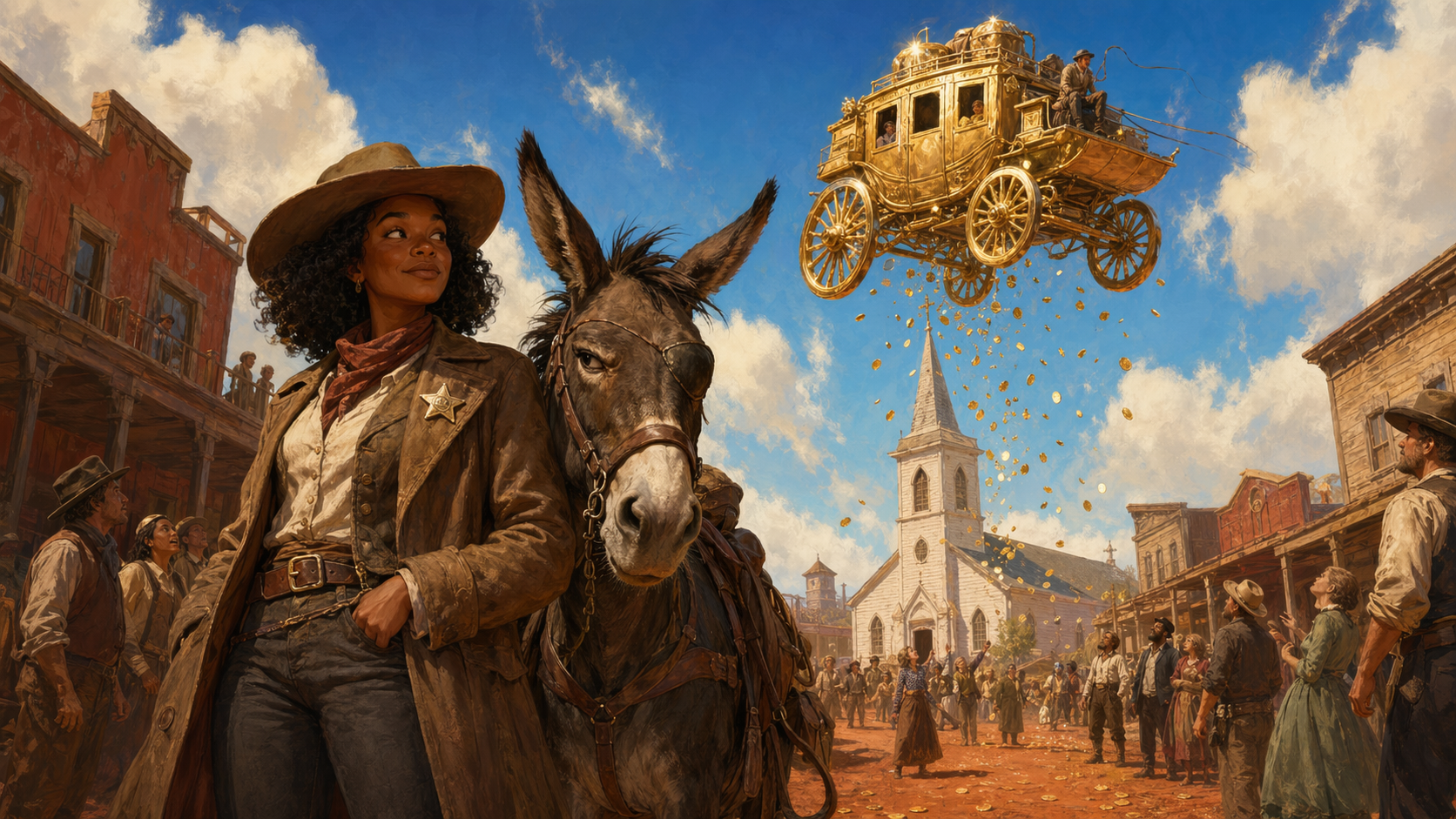
Marshal Juniper "Dust" Calloway rode into trouble the way other folks rode into town.
She came along the red road at noon with the sun behind her hat brim and the dust of half the territory on her boots. Her coat was the color of dry mesquite bark. Her revolver sat low on her hip in a silver-trimmed holster, and the mule plodding beside her looked like he had personally judged every bad decision in the West.
The mule's name was Bishop.
He had one good eye, one torn ear, and a gift for smelling disaster before it happened.
"Anything interesting ahead?" Dust asked.
Bishop gave a rough snort.
"That bad, huh?"
Dust had seen plenty already that year. She had run a card shark out of Bitter Creek with nothing but a frying pan and a law book. She had tracked a train robber through a canyon by following the smell of fancy hair oil. She had once spent three days stuck in a mine elevator with a preacher, a goat, and a woman who claimed she could speak to weather.
But the town ahead looked strange even by Dust Calloway standards.
Cinder Flats should have been noisy in a regular sort of way. Hammering from the blacksmith. Piano from the saloon. Someone hollering because a chicken had gotten loose where a chicken should not be.
Instead, the whole town stood in the street, silent and staring upward.
Dust followed their eyes.
Above the church steeple, hanging in the air like it had forgotten how gravity worked, floated a gold stagecoach.
Not gold-colored. Gold.
Its sides flashed green and yellow in the sun. Its wheels spun slowly in empty air. Every few moments the coach tipped just enough to spill a shower of coins over the town. The money bounced off roofs, wagons, hats, and one very surprised barber pole.
Dust slid out of the saddle.
"Well," she said, "that's new."
The mayor of Cinder Flats came running with his vest unbuttoned and his face shiny with panic.
"Marshal Calloway! Thank goodness. The sky has been robbing us all morning."
Dust looked back up at the floating coach.
"Looks more like somebody robbed somebody else first."
The mayor lowered his voice. "It's stolen silver. Bank marks on the sacks. The whole town's losing its mind."
He was right.
The banker was kneeling in the street with both hands full of coins, muttering numbers to himself like he might faint into mathematics at any second. Two boys were racing after silver dollars as if it were a parade. Three masked men had climbed onto the saloon roof and were trying to lasso the coach out of the sky.
One missed and roped the barber pole instead.
Another got tangled in the first man.
The third fell backward through a laundry line and came up wearing somebody's bloomers across his hat.
Dust watched for a moment.
"Outlaws?" she asked.
"Probably," said the mayor.
"Idiots?"
"Certainly."
Dust tied Bishop to the hitch rail outside the general store. The mule leaned against the post and stared at the floating coach with deep personal disappointment.
"Keep watch," Dust said.
Bishop brayed once.
"That's what I thought too."
She stepped into the center of Main Street and tipped her hat back.
"All right," she said. "Who stole the sky?"
Chapter 2: Gold From the Sky
Answers came from every direction, most of them useless.
"It exploded up there!"
"No, it rose out of Miller's Gulch like a devil kettle!"
"I seen wings on it!"
"You did not!"
"Did too!"
Dust held up one hand. The town quieted just enough for one person to be heard properly.
That person turned out to be Miss Letty Vale, owner of the telegraph office, who always talked as if every sentence should win a ribbon.
"Marshal," she said, "the stagecoach appeared at sunrise. It drifted in from the east. Then the sacks began falling. Then those three roof-climbing coyotes arrived and started claiming the coach belonged to them."
Dust looked toward the saloon roof, where the masked men were still trying to lasso air with no visible improvement in skill.
"Did they say who they ride for?"
"One of them yelled the name Blackjack Varn before he slipped on the shingles."
That got Dust's attention.
Blackjack Varn was no ordinary outlaw. He was a thief, a gambler, a tinkerer, and the only man in three territories arrogant enough to sign his crimes like they were invitations to a dance.
He had once robbed a mining office using fake survey papers.
He had once escaped jail in a collapsible coffin with breathing holes.
And six months ago he had been heard bragging in Tombstone that horses were too slow and roads were for ordinary minds.
Dust glanced up at the coach again.
"That sounds like Varn."
The mayor tugged on her sleeve. "Can you shoot it down?"
"Sure," Dust said. "If you want two thousand stolen coins raining through your rooftops and whatever fool built that machine landing on the schoolhouse."
"No."
"Then I won't."
Another sack tumbled from the coach and burst in the street. Coins rolled between boots and wagon wheels. Half the crowd lunged at once. The banker made a sound like a teakettle in pain.
Dust fired one shot into the air.
Everyone froze.
"Nobody keeps a single coin," she said. "Anything with bank marks goes back in the sacks. If I catch you stuffing your pockets, you'll be sweeping horse stalls till your grandkids complain about it."
There were grumbles, but there was also Dust Calloway's revolver, which had settled many arguments before.
As the townspeople bent to gather the silver, Dust studied the drifting coach.
It was too steady to be a balloon and too noisy to be magic. She could hear a faint clatter under the wind, metal hitting metal in a rhythm almost like a locomotive trying not to cough.
"Steam," she murmured.
Miss Letty heard her. "You think it flies with steam?"
"I think Blackjack Varn found a way to bolt too many bad ideas together."
Right then Bishop jerked hard against the hitch rail and gave a loud, angry bray.
Dust turned.
The mule was not looking at the sky.
He was looking at the water tower at the far end of town.
Three men were creeping around its base with shovels.
Not the same three on the saloon roof. These wore dust scarves and moved with the nervous speed of men doing something they hoped no one noticed.
Dust narrowed her eyes.
"Mayor."
"Yes?"
"How much do you like your water tower?"
The mayor blinked. "A normal amount?"
"You'd better go love it from up close."
She started toward the tower at a run. The mayor came stumbling after her, shouting for deputies who either did not exist or had developed a sudden interest in staying out of sight.
By the time Dust reached the tower, the three men were already backing away from a fresh patch of turned dirt.
One saw her and yelled, "Run!"
All three bolted.
Dust didn't chase them. She dropped to one knee and brushed dirt aside with both hands.
There it was.
A row of dynamite sticks, wired together and tucked under the tower supports.
"Well now," she said.
The mayor arrived panting so hard he could barely stand.
"Is that what I think it is?"
"Depends," said Dust. "If you think it's picnic candles, no."
The mayor went pale.
Dust looked back up at the floating stagecoach, then at the dynamite, then at the panicked town gathering silver in the street.
Blackjack Varn had not lost control.
He had made a plan.
The coach dropped the loot. The town rushed to grab it. Then the water tower blew, chaos took over, and the gang escaped with whatever mattered most.
Dust stood.
"Mayor, get buckets, blankets, and anybody with steady hands. Nobody touches this fuse till I say so."
"What are you doing?"
Dust checked the cinch on her saddle, then untied Bishop.
"Going up."
Chapter 3: Blackjack Varn's Trick
Dust did not have time for a proper plan, so she settled for the kind that involved speed, rooftops, and a high chance of regretting things later.
She rode Bishop straight through town.
At the dry goods store she stood in the stirrups and caught the edge of an awning.
At the tailor's she climbed from awning to balcony.
From the balcony she hauled herself onto the roof of the boardinghouse.
Someone below shouted, "Marshal, that seems unsafe!"
"Then don't copy me!" she shouted back.
Wind struck her as she reached the highest roof on Main Street. Up there, the floating stagecoach looked even stranger.
The body was built like a rich man's travel coach, but brass pipes ran along its sides. Iron tanks clung to the rear axle. At the roofline, folded vanes snapped in the wind like metal feathers. Smoke hissed from a crooked stack near the driver's box.
It was not elegant.
It was an airborne argument with common sense.
The three fools on the saloon roof had finally managed to snag one rope around the back wheel. They cheered too early. The wheel spun, wrapped the rope, and yanked them belly-first across the shingles in a single howling line.
Dust stepped onto the saloon sign, balanced once, and judged the distance.
"This is going to be annoying," she told the sky.
Then she jumped.
For one terrible heartbeat there was nothing under her boots.
Then she hit the coach roof hard enough to bite her tongue.
She slid halfway to the edge, grabbed a brass rail, and hauled herself flat while the coach rocked wildly.
"All right," she muttered. "I'm here. Everybody can stop being dramatic."
A hatch in the roof banged open below her. Steam belched upward.
Dust dropped through into the coach.
The inside looked like a gambling hall and a machine shop had gotten into a fistfight. Velvet seats were torn out to make room for gears, levers, gauges, and two large copper boilers that rattled with dangerous enthusiasm. Silver sacks were piled nearly to the ceiling.
At the front, one man wrestled the controls.
Blackjack Varn wore black gloves, a black vest, and a grin so sharp it seemed like part of the weaponry. His hair was slicked back. His mustache curved like quotation marks around a joke nobody trusted.
On his shoulder sat a green parrot with a missing tail feather.
The parrot took one look at Dust and screamed, "LAW!"
"Afternoon, Varn," Dust said.
Blackjack Varn did not turn around right away. He only yanked a lever, cursed at a gauge, and said, "Marshal Calloway. I ought to be insulted. You boarded my invention without buying a ticket."
"You dropped half your ticket money on the town."
Now he looked over. His grin widened.
"Temporary complication."
"You call dynamite under the water tower temporary too?"
"I call it insurance."
Dust's hand drifted toward her revolver. Varn noticed and laughed.
"Go ahead and draw," he said. "One stray shot and this whole machine comes down in splinters and steam."
Dust believed him.
The coach bucked sideways. One of the boilers whined like it had seen the future and disliked it.
"You built this?" Dust asked.
"Designed it. Built it. Improved it. The roads belong to sheriffs and toll men and weather. The sky belongs to the first fool bold enough to take it."
The parrot bobbed its head.
"Bold fool! Bold fool!"
Varn flicked a switch. The folded vanes outside snapped wider. The coach climbed another few feet.
"You're not climbing," Dust said. "You're circling."
That touched a nerve. Varn scowled at the gauges.
"Crosswind caught the stabilizer over Miller's Gulch. Nothing I can't solve."
The coach lurched hard enough to knock a sack of silver across the floor.
Dust smiled a little.
"Looks solved already."
Varn reached for another lever.
Dust moved first.
She kicked the silver sack into his knees, slammed the hatch behind her shut with one hand, and drove her shoulder into his middle. They crashed into the controls together. Steam screamed. The parrot exploded off his shoulder in a burst of feathers and outrage.
"Thief! Thief! Everybody's a thief!"
Varn punched fast and dirty. Dust blocked one swing, took another in the ribs, and answered with a hard right that snapped his head sideways.
He staggered into a wheel mounted on the front column.
The parrot landed on top of it and shrieked, "We're doomed!"
Outside the green clouds thickened.
Dust had noticed them before from the street, but up here they looked worse: a spinning storm wall, green as bottle glass, rolling in low over the plains.
Varn wiped blood from the corner of his mouth.
"You picked a bad time to interfere, Marshal."
Dust glanced through the front glass.
"No," she said. "You picked a bad day to fly."
Chapter 4: The Green Storm
The storm hit before either of them could say anything smarter.
Wind slammed the coach broadside.
The whole machine groaned and spun. Gauges jumped. Steam blasted from a split seam near the boiler. The parrot flapped in frantic circles, then landed on the steering wheel because panic had apparently worn out the rest of its choices.
"Hold it steady!" Varn shouted.
"That sounds like your department," Dust said.
Lightning flashed so close it turned the front glass white.
Down below, Cinder Flats had become a blur of roofs, streets, and tiny moving people. Dust caught one glimpse of Bishop near the water tower, bucking and braying like he meant to insult the whole gang personally.
Varn lunged for the controls again.
Dust caught his wrist.
"Call off your men."
"In a storm?"
"Especially in a storm."
He drove an elbow toward her head. She ducked, twisted his arm behind his back, and slammed him face-first onto the silver sacks.
The parrot screamed, "Mercy! No mercy! Maybe mercy!"
Dust yanked a length of utility cord from the side wall and tied Varn's wrists tight.
"You arrest people very rudely," he muttered into the canvas.
"You build crimes with boilers. Nobody asked your opinion."
Another blast of wind shoved the coach nose-down.
This time Dust grabbed the wheel herself.
The parrot sidestepped indignantly but did not leave.
"You know how to fly this thing?" Varn demanded.
"Absolutely not."
"Then we're dead."
"Not before you tell me which lever keeps us from becoming a crater."
Varn hesitated.
Dust tipped the wheel harder, and the coach dove toward the church steeple.
"Middle brass lever!" he shouted.
She yanked it.
The vanes outside shifted. The coach stopped diving, though it still rattled like a cupboard falling down stairs.
Below, figures swarmed around the water tower. Through sheets of rain and dust, Dust saw townspeople digging, passing sticks of dynamite hand to hand. Then Bishop kicked free of somebody's grip, charged a loose outlaw near the fuse, and sent the man sprawling into a horse trough.
Dust grinned despite herself.
"Good mule."
The mayor and two shopkeepers threw the dynamite bundle into the trough a second before the fuse sparked out. A muddy burst shot into the air, soaking half the street and probably improving several personalities.
"Your insurance is canceled," Dust told Varn.
The outlaw looked disgusted. "That mule has no respect for enterprise."
The storm tightened around them.
Green clouds spun. Wind shrieked through the vanes. Coins still trapped in the coach rattled like hail in every corner.
Dust's hands were slick on the wheel now.
"Where do I put this thing down?"
Varn laughed once, a short sharp sound.
"You don't. It lands where it wants."
"Wrong answer."
She scanned the town.
The schoolhouse was too close to the street.
The livery was full of horses.
The church had enough problems already.
Then she saw the cemetery on the far edge of town, wide open except for a row of leaning stones and one big marble monument nobody had ever polished kindly.
"That'll do."
She aimed for it.
Varn actually looked alarmed now.
"You cannot be serious."
"I can when I'm tired."
The coach ripped through the edge of the storm, dropping out of the green clouds in a howl of steam and metal. Wheels clipped the top branch of a cottonwood. One vane snapped free and whirled away across the graveyard like a silver scythe.
Dust hauled the wheel left.
The coach slammed into the cemetery dirt, bounced once, crushed a fence, and skidded to a stop against the marble monument.
For a moment everything was silent except the soft tick tick tick of cooling brass.
The parrot puffed its feathers and said in a much calmer voice, "Bad landing."
Dust let go of the wheel and breathed.
"Still better than dying."
The hatch burst open above as townspeople came running through the gate. The mayor arrived first, soaked, muddy, and carrying half a shovel.
He stared at the wrecked flying coach, then at Varn trussed on the silver sacks, then at Dust.
"Marshal," he said, "did you just arrest the sky?"
Dust stood, wincing at a bruise in her side.
"Only the part that was stealing."
Chapter 5: The Map on the Cactus
By sundown, Cinder Flats had its town back.
The stolen silver was counted, sacked, and locked away under three separate witnesses and one banker who kept trying to recount everything out of nervous habit. Blackjack Varn was hauled to the jail in leg irons and bad temper. His remaining gang members were rounded up from the water tower, the saloon roof, the horse trough, and one particularly humiliating position beneath the widow Harker's porch.
The parrot was placed in the mayor's office under temporary supervision and spent most of the evening shouting, "No confidence! No confidence!"
As for the flying coach, nobody could decide whether to call it evidence, scrap, or a warning from the Lord.
Dust called it heavy.
The people of Cinder Flats wanted speeches.
They wanted handshakes.
They wanted Dust to stand on the saloon balcony while the mayor praised her courage, judgment, and uncommon roof-leaping ability.
Dust accepted one plate of beef and beans, one cup of coffee, and exactly one silver dollar for the trouble.
"One dollar?" the mayor said. "After all that?"
Dust shrugged.
"I didn't do it for the money."
"Then why only one?"
"Because your town still needs a new water tower brace, three roof repairs, and probably a stronger church steeple."
The mayor considered that and nodded.
"Fair."
Later, in the quiet after dark, Dust walked through the cemetery where the sky coach had landed. Moonlight silvered the bent fence and the torn earth around the skids. The marble monument it had cracked belonged to Horace Bellweather, a local man remembered mainly for cheating at cards, cheating at land sales, and once trying to charge admission to his own wedding.
Dust studied the broken stone.
"Couldn't have happened to a finer memorial," she said.
Bishop cropped weeds beside the fence and made no argument.
At dawn the next morning, Dust saddled up before the town could organize a parade she did not want.
Miss Letty handed over a clean bandage for her ribs. The banker tipped his hat as if he had personally been rescued from arithmetic. The mayor offered her a deputy badge for Cinder Flats.
Dust declined.
"You don't want steady work?" he asked.
"Steady work gets bored with me."
She swung into the saddle, checked the road east, and was about to ride when Bishop stopped dead beside a tall cactus at the edge of town.
Something was pinned to it with a knife.
Dust dismounted and pulled free a folded scrap of leather.
Inside was a rough map.
The ink showed a line of mesas, a dry river bend, and a place marked only with an X deep in the badlands. Underneath, in a fast slanted hand, someone had written:
TO THE WOMAN WHO TAMES STORMS:
MEET ME AT THE CANYON OF BONES.
No name.
No explanation.
No promise that any of it was sensible.
Dust smiled anyway.
"That," she said, "is exactly how new trouble introduces itself."
Bishop gave a doubtful snort.
"I know. Probably a trap."
He snorted again.
"Almost certainly a trap."
Dust tucked the map into her coat.
Behind her, Cinder Flats was waking up. Ahead, the long country opened red and gold under the morning sun.
She touched two fingers to the brim of her hat.
"Come on, Bishop," she said. "Reckon we ain't done yet."
Then marshal and mule rode east toward the Canyon of Bones and whatever wild thing was waiting there next.